

Ask an AI chat how to grow online sales in a market and you get a confident answer: fix conversion first. It sounds right. On real data, it was wrong.
We ran that question for a premium consumer brand, this time on the brand’s own data. The answer changed completely. Conversion had barely moved. The real problem was reach: far fewer people were getting to the products at all. Same question, opposite advice. The difference was not a smarter model. It was the data underneath it.
That is the core message of this post. AI only creates value for growth when three loops work together.
Loop one: the agent
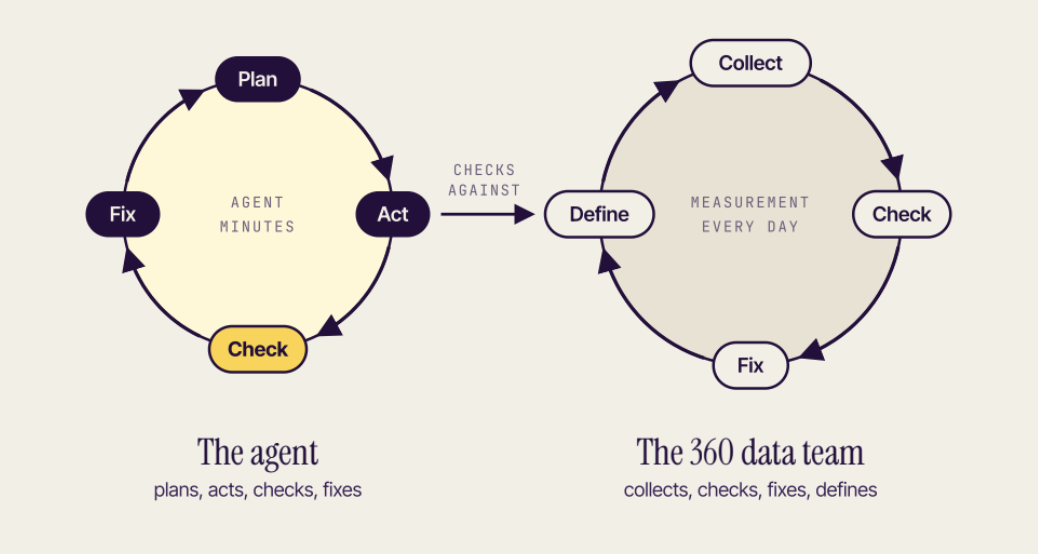
A chat answers once. An agent works in a loop: it plans what to look at, acts, checks the result and fixes what failed. It only answers when the check passes.
But a check needs something real to check against. Without data from outside the model, the loop is just the model agreeing with itself.
In our case, the checks caught two things that would have sent the brand in the wrong direction. A cheap accessory, partly given away for free, made conversion look better than it was. And tens of thousands of bot-like sessions from outside the market were inflating traffic. Both were set apart before any conclusion was drawn.
Loop two: the data, kept true every day
The agent checks against a marketing lake: one curated place where web-store orders, web analytics, paid media, organic search and attribution come together. Read-only, with clear rules on how each table should be read, and what it cannot answer.
A lake is not a one-off project. Platforms, sites and campaigns change every week, so keeping the data true is never done. It depends on everyday discipline:
- Campaign naming. If a campaign name doesn’t follow the convention, its spend lands in the wrong category, or in none. The agent’s answer looks just as convincing, but it is not right.
- Product feeds. Missing categories, colours or prices hurt Shopping and Performance Max, and make “which category did best?” impossible to answer.
- Tracking and definitions. What is a returning visitor? Back within 30 days, within 90, on the same device? In GA4, where a user is a browser cookie, 90 to 96% of a summer’s users show up as new. If nobody fixes the definition, the agent improvises.
3. Overlap Zones (Where Things Get Interesting)
As these layers converge, new overlap zones emerge where control is shared, contested, or strategically outsourced — creating both friction and opportunity for brands.
Loop three: people guiding AI
The agent didn’t choose the question. A person did: why revenue fell, not how to grow. A person decided which data to leave out. And the reason a bidding strategy changed was in the team’s notes, not in any table.
As AI makes producing things cheap, choosing becomes the skill. A field experiment by researchers at MIT and Johns Hopkins found human-AI teams produced about 50% more ads per person, but those ads were also more alike. Ethan Mollick puts it simply: “The scarce resource is your ability to select among stuff using your own taste.”
So the people around the agent matter more, not less: deep knowledge to spot a wrong answer, wide knowledge to ask the right question, taste to choose, and the agency to try it on real work.
How we bring this to brands: build, operate, grow
This is exactly how we work with clients.
- Build. We set up the marketing lake on your own data: the sources, the connectors, the definitions and the reading rules an agent needs.
- Operate. Our 360 data team keeps it true every day: naming, feeds, tagging and definitions, checked and fixed as your platforms and campaigns change.
- Grow. On top of that foundation, we put the agent to work. First conversations with answers that cite their sources, then scheduled insights, then explaining what changed and why, and eventually recommendations and actions, always approved by a person.
And we do it as one team with your people. Your teams know the brand, the market and the context no table holds. Ours bring the data, the tooling and the growth experience. The agent works best with both.
The takeaway
AI tools are in everyone’s hands now. The difference is no longer the model, but the data it checks against and the people who guide it.
Curious what a marketing lake could look like for your brand, or what your own data would say about your growth? Get in touch with the naYan team.